

Certified U.S. Data Privacy Officer PECB Training Course
Why should you attend?
In today’s data-driven environment, protecting personal information has become a critical responsibility for organizations. Privacy not only safeguards individuals’ rights and gives them control over their personal data, but it also plays a key role in building trust between consumers and organizations. When people feel confident that their information is handled responsibly
and transparently, they are more likely to engage with products and services.
For organizations, strong privacy practices help protect brand reputation, reduce legal and financial risks, and ensure compliance with regulatory requirements. By prioritizing data privacy, organizations can strengthen their credibility and demonstrate their commitment to responsible data management.
This training equips professionals with the knowledge and practical understanding needed to support privacy initiatives, promote responsible data handling, and contribute to building trust and compliance within their organizations
Who should attend?
This training course is intended for:
- Data privacy officers and data protection officers
- Compliance and risk management professionals
- Information security and cybersecurity specialists
- Legal and regulatory professionals involved in privacy matters
- IT managers and professionals responsible for handling personal data
- Consultants and advisors supporting privacy and data protection program
Learning objectives
By the end of this training course, participants will be able to:
- Analyze the concepts and requirements of U.S. privacy law, including key federal statutes (e.g., HIPAA, GLBA, COPPA, FERPA, FCRA) and leading state laws (CCPA/CCPAR, CPA)
- Explain the relationship among U.S. laws, regulatory guidance, and standards, and apply recognized frameworks (NIST Privacy Framework) to support compliance and governance
- Acquire the competence to perform data mapping, policy development, cybersecurity audits, training, and stakeholder engagement
- Implement security controls designed to protect personal data and support privacy compliance
- Provide information and advice regarding U.S. privacy obligations, monitor compliance with the latter, manage data-subject requests and vendor risk, and coordinate incident response and notifications
Detailed agenda of the training course
Day 1: U.S. regulatory ecosystem, privacy principles, standards introduction
Section 1: Training course objectives and structure
- General information
- Educational approach
- Agenda of the training course
- Learning objectives
- Examination and certification
- About PECB
Section 2: U.S. privacy laws
- S. legal and constitutional terms
- Hierarchy of legal authority in U.S.
- Federal privacy laws and regulations in the U.S.
- Federal Trade Commission (FTC)
- Gramm-Leach-Bliley Act
- FTC Safeguards Rule
- Executive Order 14117 and the Final Rule
- State privacy laws in the U.S.
- Consumer rights vs. requirements under U.S. state privacy laws
Section 3: International privacy frameworks and data protection laws
- Data protection laws worldwide
- Europe data protection laws
- Asia-Pacific data protection laws
- Africa data protection laws
- United Kingdom data protection laws
Section 4: Fundamental data privacy concepts and principles
- Data privacy
- Definitions in U.S. context
- Environments of data protection
- Fair information practice principles (FIPPs)
Day 2: Privacy governance, compliance obligations, and risk assessment
Section 5: Leadership and governance
- Data protection leadership
- Privacy compliance leadership
- NIST-aligned privacy governance
Section 6: DPO role and organizational responsibilities
- Business structure in U.S.
- Organizational privacy governance models
- Data governance team
- Data privacy officer (DPO)
- DPO relevant roles in the U.S.
Section 7: Consumer rights and business obligations
- Consumer rights and business obligations under CCPA regulations
- Consumer rights and business obligations under FTC Safeguards Rule
- Shared consumer rights across U.S. states
- Shared business or controller requirements across U.S. states
- State-specific consumer rights variations
- State-specific business compliance requirements
Section 8: Privacy risk assessment
- Privacy risk assessment
- Risk assessment in U.S. federal privacy laws
- State-level risk assessments
- NIST risk assessment process
Day 3: Data security, records management, and cross-border data governance
Section 9: Data security measures
- Importance of data security measures
- Key security measures for protecting personal data
Section 10: Processing records management
- Documentation requirements under the FTC
- Documentation and recordkeeping across U.S. state privacy laws
- Documentation requirements based on the rule issued under Executive Order 14117
- Recordkeeping obligations under the CCPA
- Documentation and recordkeeping practices
Section 11: Vendor and cross-border data management
- Data management within and outside the U.S.
- Key steps for complying with data transfers in the U.S
- Cross-border data transfers checklist
Day 4: Cybersecurity audits, incident management, and continuous monitoring and training
Section 12: Cybersecurity audit
- Cybersecurity audit
- Types of cybersecurity audits
- Audit principles
- Audit requirements under GLBA
- Audit requirements of the Final Rule Issued under Executive Order 14117
- Cybersecurity audit under CCPA regulation
- Audit reports
Section 13: Incident management
- Personal information security breaches
- Covered entities
- Notification content and procedures and contingency planning
Section 14: Training and continuous monitoring
- Importance of employee training and monitoring
- Key components of an effective privacy awareness training
- Principles of effective employee training
- Key components of continuous security monitoring
- Continuous monitoring tools
Section 15: Closing of the training course
- PECB certification scheme
- Attestation of course completion
- PECB certification process
- Other PECB services
- Other PECB training courses and certifications
Examination
Duration: 3 hours
The “PECB Certified U.S. Data Privacy Officer” exam fully meets the PECB Examination and Certification Program (ECP) requirements. It covers the following competency domains:
- Domain 1 Privacy foundations and regulatory framework
- Domain 2 Privacy governance, leadership, and organizational roles
- Domain 3 Consumer rights, business obligations, and compliance
- Domain 4 Privacy management and data security measures
- Domain 5 Records management and privacy audit
- Domain 6 Incident management, monitoring, and continual improvement
For specific information about the exam type, languages available, and other details, please visit the List of PECB Exams and Exam Rules and Policies
Certification
After passing the exam, you can apply for one of the credentials in the table below.
You will receive a certificate once you fulfill all the requirements of the selected credential. The certification requirements for Certified U.S. Data Privacy Officer are:
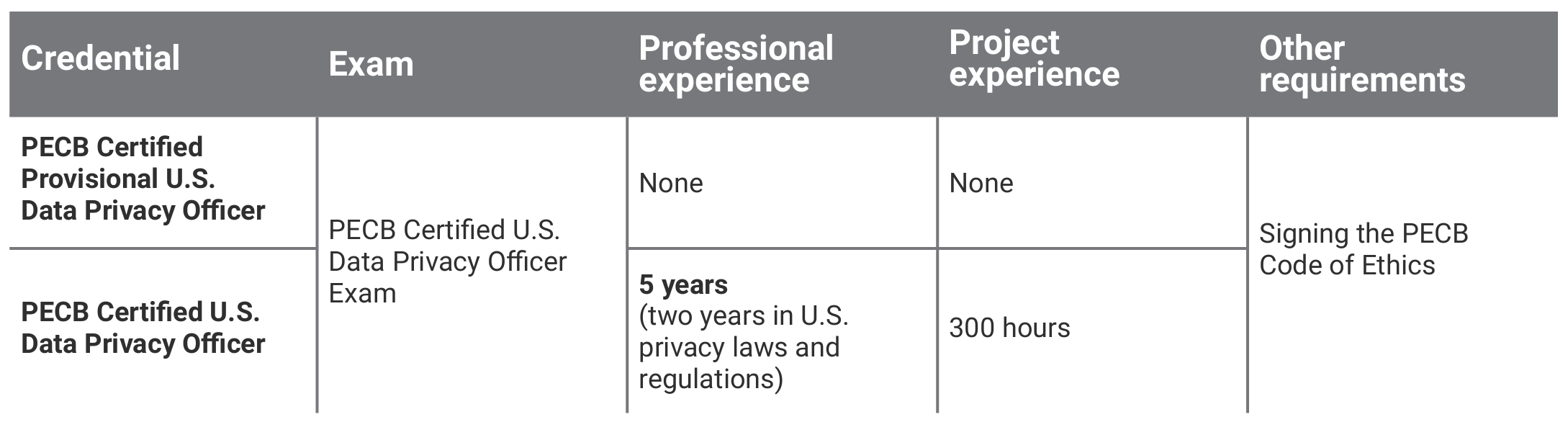
PECB Certified U.S. Data Privacy Officer
The data privacy officer training activities should follow best practices and include the following:
- Publishing and maintaining a compliant privacy policy describing data practices and consumer rights
- Offering mechanisms for consumers to exercising rights to know, delete, correct, and opt out
- Governing service providers, contractors, and third-party data disclosures through required contracts
- Limiting collection, use, retention, and sharing of personal information to necessary and proportionate purposes
- Conducting privacy risk assessments and overseeing automated decision-making technology
- Maintaining a cybersecurity program and completing required cybersecurity audits
- Delivering workforce privacy training and retaining compliance-related records
For more information about the PECB certification process, please refer to Certification Rules and Policies.
General information
- For candidates who complete a training, eLearning, or self-study course delivered by a PECB Partner, the training fee includes the first exam attempt, one free retake, the certification application fee, and the first year of the Annual Maintenance Fee (AMF). This cycle must be completed within 12 months from the course completion date for instructor-led training, or within 12 months from the purchase date for self-study and eLearning formats.
- Candidates will receive more than 400 pages of comprehensive training materials, including practical examples, exercises, and quizzes.
- An attestation of course completion worth 31 CPD (Continuing Professional Development) credits will be awarded to the candidate.
- If the initial exam is not passed, a free retake may be taken within 12 months of the course completion date. For self-study or eLearning courses, the 12-month period is calculated from the date of purchase