

The International Labour Organization (ILO) estimates that every year, around 2.3 million workers around the world die from work-related accidents. According to ILO, every year, worldwide, there are around 340 million occupational accidents and around 160 million are victims to work-related illnesses. While in the past decades, great efforts were made to improve the health and safety of workers, there is still a lot that must be done. To tackle the issues related to the health and safety of workers, ISO has developed ISO 45001, an international standard that defines the requirements for an occupational health and safety management system (OH&S MS).
Learning Objectives
By the end of this training course, the participant will be able to:
- Explain the fundamental concepts and principles of an occupational health and safety management system (OH&S MS) based on ISO 45001
- Interpret the ISO 45001 requirements for an OH&S MS from the perspective of an implementer
- Initiate and plan the implementation of an OH&S MS based on ISO 45001, by utilizing PECB’s IMS2 Methodology and other best practices
- Support an organization in operating, maintaining, and continually improving an OH&S MS based on ISO 45001
- Prepare an organization to undergo a third-party certification audit
Why should you attend?
The PECB ISO 45001 Lead Implementer is a five-day training course that aims to equip you with the competence to establish, implement, manage, and maintain an occupational health and safety management system (OH&S MS) in accordance with ISO 45001:2018 requirements and guidance. This training course aims to provide an in-depth understanding of ISO 45001 requirements, as well as the best practices and approaches used for the implementation and subsequent maintenance of an OH&S MS. The ultimate ambition of this training course is to enable you to create the conditions for a safer workplace.
The training course is followed by the certification exam. If you pass, you can apply for the “PECB Certified ISO 45001 Lead Implementer” credential. IAS accredited and internationally recognized, the “PECB ISO 45001 Lead Implementer” certificate validates your competence to implement an OH&S MS based on the requirements of ISO 45001.
Who should attend?
The ISO 45001 Lead Implementer training course is intended for:
- Individuals responsible for maintaining and improving the workplace safety
- Occupational health and safety officers, consultants, and advisors
- Professionals wishing to acquaint themselves with PECB’s IMS2 Methodology for implementing an OH&S MS
- Individuals responsible for maintaining the conformity of OH&S MS to ISO 45001 requirements
- Members of OH&S teams
- Individuals aspiring to pursue a career as OH&S MS implementers, consultants, or officers
Educational Approach (For instructor led classes)
This training course is participant centered and contains:
- Theories, approaches, and best practices used in OH&S MS implementation
- Illustrative examples throughout the four days of the training course
- Lecture sessions illustrated with practical examples based on a case study that includes role-playing and discussions
- Interaction between participants by means of questions and suggestions
- Quizzes with stand-alone items (after each section) and scenario-based quizzes (at the end of each day), intended to prepare the participants for the certification exam
Prerequisites
The main requirements for participating in this training course are a basic knowledge of ISO management system standards, a general understanding of ISO 45001, and the MS implementation principles.
Course Agenda
Introduction to ISO 45001 and initiation of an OH&S MS implementation
- Training course objectives and structure
- Standards and regulatory frameworks
- Fundamental concepts and principles of OH&S
- Initiation of the OH&S MS implementation
- The organization and its context
Implementation plan of an OH&S MS
- Leadership and worker participation
- OH&S MS scope
- OH&S policy and objectives
- Hazard identification and assessment of risks and opportunities
Implementation of an OH&S MS
- Resource management
- Awareness and communication
- Documented information management
- Operations management
- Emergency preparedness and response
OH&S MS performance evaluation, continual improvement, and preparation for the certification audit
- Monitoring, measurement, analysis, and evaluation
- Internal audit
- Management review
- Treatment of nonconformities and incidents
- Continual improvement
- Preparation for the certification audit
- Closing of the training course
Certification Exam
- 3 Hours Exam
Examination
The “PECB Certified ISO 45001 Lead Implementer” exam fully meets the requirements of the PECB Examination and Certification Programme (ECP). It covers the following competency domains:
- Domain 1: Fundamental principles and concepts of OH&S and OH&S MS
- Domain 2: Initiation of an OH&S MS implementation
- Domain 3: Planning of an OH&S MS implementation based on ISO 45001
- Domain 4: Implementation of an OH&S MS based on ISO 45001
- Domain 5: OH&S MS performance evaluation
- Domain 6: Continual improvement of an OH&S MS based on ISO 45001
- Domain 7: Preparing for an OH&S MS certification audit
For specific information about exam type, languages available, and other details, please visit the List of PECB Exams and the Examination Rules and Policies.
Certification
Upon the successful completion of the exam, you can apply for one of the credentials shown in the table below. You will receive a certificate once you fulfill all the requirements related to the selected credential. For more information about ISO 45001 certifications and the PECB certification process, please refer to the Certification Rules and Policies.
The credentials in the PECB ISO 45001 certification scheme have the following requirements:
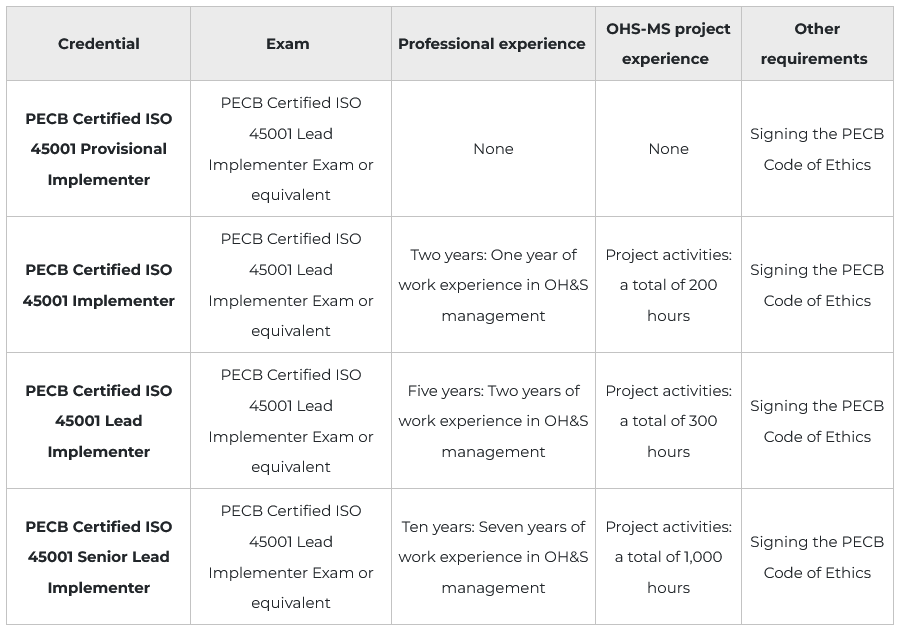
PECB Certified ISO 45001 Lead Implementer Occupational Health and Safety Management System
Note: PECB certified individuals who possess the Lead Implementer and Lead Auditor credentials are qualified for the respective PECB Master credential, given they have taken four additional Foundation exams related to the scheme. For more information about the Foundation exams and the overall Master credential requirements, go to https://pecb.com/en/master-credentials.
To be considered valid, the implementation activities should follow best practices and include the following:
- Drafting an OH&S MS plan
- Managing or leading an OH&S team
- Initiating an OH&S MS implementation
- Implementing an OH&S MS
- Managing documented information
- Monitoring the OH&S MS performance
- Performing continual improvement activities
Why set guidelines and procedures for OH&S?
There is no doubt that poor occupational health and safety practices bring enormous emotional distress, human costs, and economic burden. Therefore, organizations should employ a systematic approach to OH&S management.
Health and safety guidelines and procedures will help organizations to:
- Prevent illnesses and injuries in the workplace: OH&S guidelines and procedures aim to promote health and safety in the workplace and protect workers from risks and hazards related to their health, safety, and well-being. The implementation of such guidelines and procedures contributes to the reduction of work-related illnesses and injuries.
- Reduce health and safety hazards and risks
Organizations use different equipment and tools to do their work. As such, proper usage and personal care when working with organizational equipment is essential. Detailed guidelines and concise procedures for equipment use will enable organizations to reduce the health and safety hazards and risks in the workplace.
- Prevent unwanted consequences
Well-constructed guidelines and procedures will help both workers and organizations to prevent the negative consequences of health and safety risks and hazards.
Benefits of ISO 45001 for organizations
An effective OH&S MS based on ISO 45001 has the potential to shape and improve an organization’s way of working and can make the workplace a safer and better place.
Some of the benefits that organizations would gain by implementing an OH&S MS based on ISO 45001 include, but are not limited to:
- Enhanced reputation among internationally recognized businesses as a result of implementing the best practices of occupational health and safety
- Increased trust of employees by demonstrating that the organization is committed to improve their safety and health in the workplace
- Reduced insurance premiums and claims
- Increased return on investment due to improved staff productivity, while the injuries within the workplace will be reduced
- Reduced employee turnover because the main focus will be in the mental and physical well-being of the employees
For more information, visit the PECB PECB Certified ISO 45001 Lead Implementer | Occupational Health and Safety Management System course
Download the brochure PECB Certified ISO 45001 Lead Implementer | Occupational Health and Safety Management System